

In 2026, the creator economy has merged with the software economy. It is no longer enough to just build a brilliant product—whether that is a click-to-chat WordPress plugin, a mobile app, or a digital children’s book. The “Build It and They Will Come” myth has been thoroughly debunked. Today, distribution is everything, and your most valuable distribution channel is an audience you actually own: your email list.
The “Golden Rule” of 2026 email marketing for creators is Seamless Integration. You shouldn’t be spending hours manually exporting CSV files from your blog or your app dashboard. The platforms that dominate 2026 are those that offer robust APIs, native CMS integrations, and the ability to trigger transactional emails seamlessly when a user interacts with your software or downloads your content.
The most effective way to grow your brand today is to connect your marketing directly to your product ecosystem. This step-by-step guide to the top 5 free email tools of 2026 will show you exactly how to build a high-converting retention engine for $0.

1. MailPoet: The WordPress Native Engine
If your digital presence is built on WordPress—especially if you are running a dedicated blog on a subdomain or developing your own custom plugins—MailPoet is the undisputed champion of 2026. It lives entirely inside your WordPress dashboard.
- Zero Context Switching: As a developer or content marketer, context switching kills productivity. MailPoet allows you to write, design, and schedule your newsletters without ever leaving the WP admin panel. You can literally pull your latest blog posts directly into your email template with one click.
- The Free 1,000 Subscriber Tier: MailPoet’s free plan allows you to send unlimited emails to up to 1,000 subscribers. Crucially, this includes access to their highly reliable sending infrastructure, meaning your emails won’t end up in the spam folder just because they are coming from your own server.
- WooCommerce & Digital Product Integration: If you are selling digital assets—like an ebook on food facts or a premium version of a WordPress plugin—MailPoet integrates natively with WooCommerce. You can set up automated “Welcome” emails the moment someone downloads your product, or “Abandoned Cart” emails to recover lost sales.
- Plugin Synergy: Because it is a WP plugin itself, it plays incredibly nicely with your existing tech stack. If you have built custom widgets for your site, MailPoet’s forms can be injected anywhere using simple shortcodes or Gutenberg blocks, keeping your site’s code clean and lightweight.
A common mistake to avoid is trying to use your web host’s default mail server to send MailPoet campaigns. In 2026, shared hosting IPs are frequently blacklisted by Gmail. Always route your emails through the free MailPoet Sending Service to guarantee a 99% deliverability rate.
2. MailerLite: The UI/UX Designer’s Dream
For those who have a background in graphic design and UI/UX, clunky email builders are incredibly frustrating. MailerLite is the 2026 industry favorite for its immaculate, modern interface and its generosity regarding premium features on the free tier.
- Flawless Visual Builder: MailerLite’s editor is a masterclass in clean UI. You can build complex, multi-column layouts, embed videos, and use dynamic content blocks that adapt perfectly to mobile screens. For a designer, the ability to control padding, margin, and typography at a granular level is a breath of fresh air.
- Digital Download Delivery: If you are publishing digital content (like a children’s discovery guide or a zip file of meditation music tracks), MailerLite is the easiest way to deliver it. You can build a highly converting, free landing page directly in their app, and use their automation tools to instantly email the file when someone signs up.
- 12,000 Emails / 1,000 Subscribers Free: The free tier gives you access to automations, a drag-and-drop editor, and up to 10 landing pages. This is more than enough infrastructure to launch a new brand or test a new Chrome extension idea without any financial risk.
- Unsubscribe AI Management: In 2026, list hygiene is vital for SEO and brand reputation. MailerLite automatically scrubs inactive subscribers and manages soft/hard bounces, ensuring your metrics stay pristine and your sender reputation remains high.
3. Brevo (Formerly Sendinblue): The Developer’s Back-End
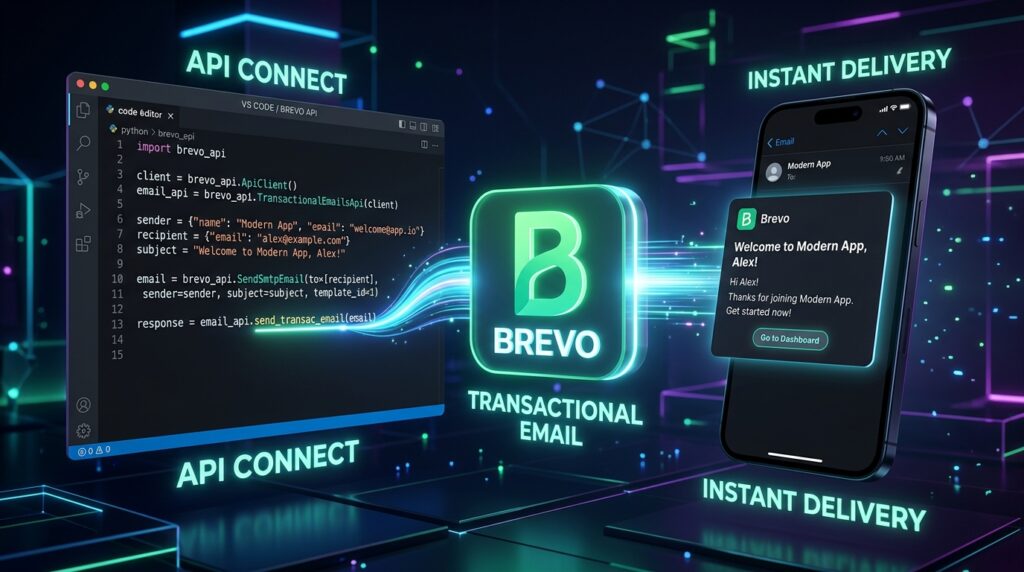
If you are building mobile apps (using frameworks like Ionic) or coding browser extensions (like an emoji keyboard or color picker), your email marketing needs are different. You need a platform that excels at Transactional Emails. Brevo is the ultimate developer’s tool for 2026.
- The Transactional MVP: When a user creates an account on your mobile app, or requests a password reset, that email needs to arrive in seconds. Brevo’s API and SMTP relay are industry-standard. You can trigger these emails programmatically directly from your app’s codebase.
- Unlimited Contacts: Brevo operates on a different model than the rest. They don’t care how many people are on your database; you can have 50,000 app users on the free plan. The limit is on sending volume (300 emails per day on the free tier).
- Webhook Architecture: For developers, Brevo’s webhook integration is flawless. You can set it up so that when a user reaches a certain milestone in your app, or installs your Chrome extension, a webhook fires to Brevo, instantly moving that user into a specialized automated email workflow.
- Multi-Channel Onboarding: Brevo allows you to send SMS messages alongside your emails. If you are launching a high-ticket software product, a multi-channel onboarding sequence ensures your users actually install and understand your tool.
4. Kit (Formerly ConvertKit): The Content Publisher’s Hub
Recently rebranded as Kit, this platform is the absolute gold standard for authors, musicians, and digital content creators who want to build a deep, personal connection with an audience. If your goal is to publish books or stream media, this is your engine.
- The Creator Network: Kit’s most powerful 2026 feature is decentralized growth. When someone signs up for your newsletter, Kit recommends 2-3 other creators in your niche. In return, those creators recommend you. This peer-to-peer network is currently the fastest way to get your first 1,000 readers without spending a dime on ads.
- Text-Forward Philosophy: Kit deliberately avoids overly complex, image-heavy templates. Data in 2026 shows that plain-text emails (which look like they were typed by a friend) have a 30% higher open rate than flashy, corporate newsletters. This minimalist approach focuses entirely on your copywriting and storytelling.
- Visual Automations: Their automation builder maps out your customer journey like a logic tree. If a subscriber buys your children’s book, the automation visually moves them out of the “Pitch” sequence and into the “Customer Thank You” sequence, preventing you from accidentally pitching a product to someone who already owns it.
- Tip Jars & Paid Newsletters: If you want to monetize your knowledge directly, Kit allows you to set up “Tip Jars” or launch a paid, premium version of your newsletter directly through their platform, bypassing the need for third-party payment gateways.
5. Sender: The High-Volume E-commerce Alternative
For creators who are rapidly scaling their digital storefronts and quickly outgrowing the 1,000-subscriber limits of other platforms, Sender offers the most generous free tier in the 2026 market.
- 2,500 Subscribers / 15,000 Emails Free: This massive free tier allows you to scale your content marketing efforts significantly before ever having to pull out a credit card.
- Custom HTML Access: If you know how to code, Sender doesn’t restrict you to their drag-and-drop blocks. You can dive directly into the HTML to build custom, highly specific email templates that perfectly match your brand’s unique UI/UX guidelines.
- Advanced E-commerce Triggers: Sender integrates beautifully with major e-commerce platforms. It tracks when a user views a specific product page on your website, allowing you to trigger a highly specific email based on their browsing history (e.g., “We saw you looking at the click-to-chat plugin! Here’s a 10% discount”).
- Spam-Proof Delivery: Sender maintains an incredibly strict anti-spam policy for its users. Because they aggressively police their network, the IP addresses you send from are highly trusted by Gmail and Outlook, ensuring your newsletters actually hit the inbox.
Comparison: Which Free Tool Matches Your Build?
| Platform | Best For | Technical Strength | 2026 Free Tier Limit |
| MailPoet | WP Developers / Bloggers | Native WordPress Plugin | 1,000 Subs / Unlimited Sends |
| MailerLite | UI/UX Pros / Digital Goods | Landing Pages & Clean UI | 1,000 Subs / 12,000 Sends |
| Brevo | App & Extension Devs | APIs & Transactional Mail | Unlimited Subs / 300/Day |
| Kit | Authors & Musicians | Creator Growth Network | 1,000 Subs / Unlimited Sends |
| Sender | High-Volume Sellers | Custom HTML Access | 2,500 Subs / 15,000 Sends |
The 2026 “Dev-to-Founder” Strategy: 3 Steps to Automation
Building a product is only 50% of the journey. To create a sustainable business around your software or content, you must build an automated funnel. Here is the blueprint:
- Phase 1: The High-Value Lead Magnet (MailerLite or MailPoet): Do not ask people to “Subscribe for updates.” No one wants updates. Offer a specific solution. If you are targeting developers, offer a “Free Snippet Library.” If you are targeting readers, offer a “Free Chapter.” Connect this directly to a landing page or a WordPress pop-up.
- Phase 2: The API Handshake (Brevo): If you are building a SaaS, an app, or an extension, ensure your code talks to your email software. When a user experiences their first “Aha!” moment in your app, use a webhook to trigger a congratulatory email. This reinforces the UI/UX experience and drops churn rates drastically.
- Phase 3: The Content Loop (SEO + Email): Use your blog to drive organic SEO traffic to your lead magnets. Once they are on your email list, send them your newest blog posts to drive traffic back to your site. This creates a closed-loop ecosystem where your SEO fuels your email list, and your email list fuels your SEO ranking via direct traffic signals.
Final Thoughts
Email marketing in 2026 is the ultimate bridge between writing great code and building a great business. Whether you are crafting complex WordPress architecture, designing beautiful mobile interfaces, or writing books that spark imagination, your email list is the vault where your audience lives.
By leveraging the WordPress synergy of MailPoet, the API power of Brevo, or the creator network of Kit, you are insulating your brand against algorithm changes and platform bans. The tools to build your audience are entirely free. The infrastructure is waiting. Your only job now is to start collecting the most valuable asset on the internet: the inbox.





Leave feedback about this