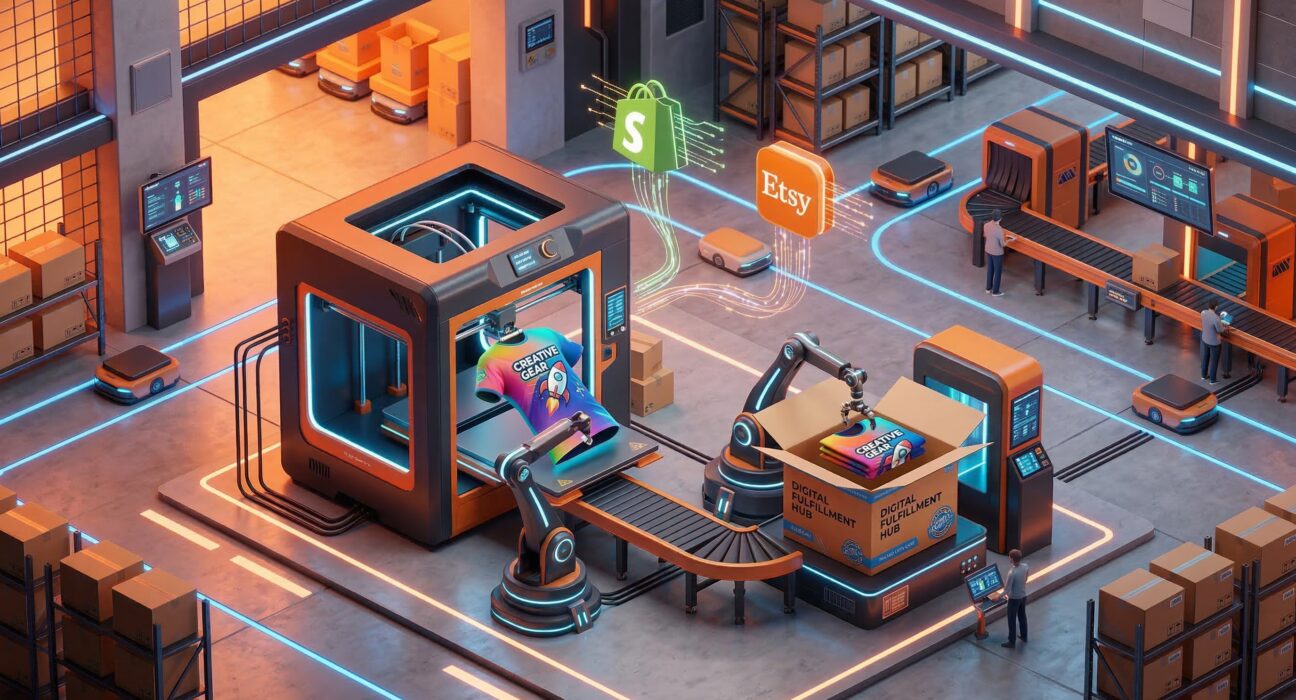
In 2026, the retail landscape has undergone a radical shift. The era of “buy low, sell high” inventory management is fading, replaced by the “Sell-then-Source” model. Print-on-Demand (POD) is no longer just a way to sell t-shirts; it is a sophisticated fulfillment ecosystem powered by AI design, global manufacturing, and social commerce integration.
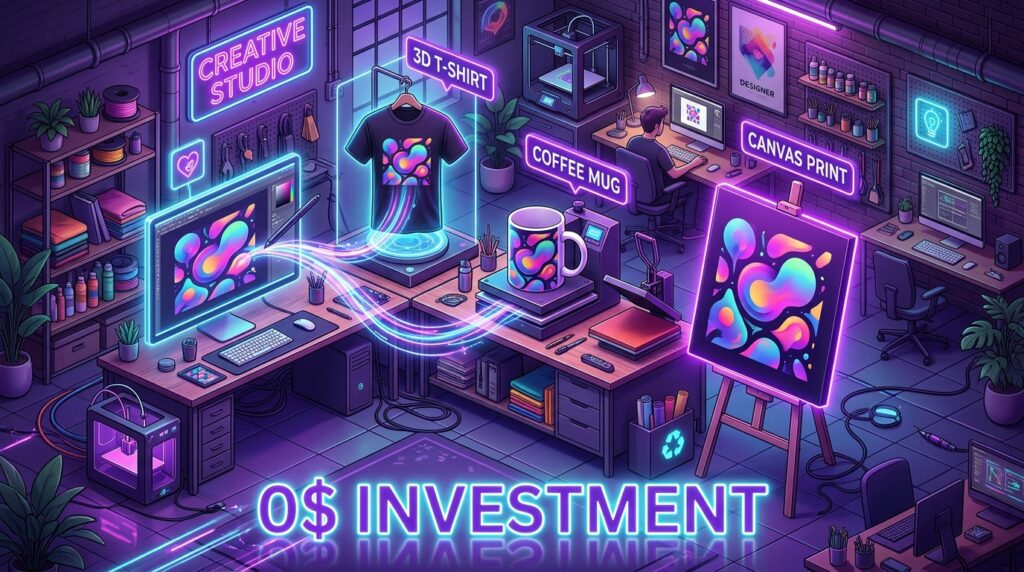
The barrier to entry has never been lower. Today, you don’t need a warehouse, a printing press, or even a credit card to start. You simply need a digital design and a platform that handles the rest. In 2026, the best platforms have integrated Generative AI directly into their dashboards, allowing you to turn a text prompt into a high-selling product in seconds.
The most effective way to scale a POD brand in 2026 is to focus on Niche Personalization. Consumers no longer want “generic” apparel; they want items that speak to their specific hobbies, pets, or micro-local trends. This step-by-step guide to the top free POD websites will show you exactly which platform fits your specific business goals.

1. Printify: The Margin-Focused Powerhouse
Printify remains the champion of 2026 for sellers who prioritize profit margins and product variety. Unlike other platforms, Printify is a “network”—it doesn’t print the shirts itself but connects you to over 90 print providers globally.
- The Largest Catalog in 2026: With over 1,000+ products (ranging from standard hoodies to high-end tech accessories and eco-friendly home decor), Printify offers the most “room to play” for your brand.
- The “Print Provider Optimizer”: New for 2026, Printify’s AI-driven optimizer automatically selects the best print provider based on your customer’s location, shipping cost, and real-time quality ratings. This ensures your customer in Sydney gets their shirt as fast as your customer in New York.
- Unbeatable Margins: Because you can choose your provider, you can “shop around” for the lowest base cost. In 2026, this remains the best way to keep your retail prices competitive while still netting a $10–$15 profit per shirt.
- Printify Pop-Up Store: For beginners who don’t want to build a complex Shopify or Etsy store, Printify now offers a free “Pop-Up” storefront. You can launch a dedicated URL for your brand in under 5 minutes without any hosting fees.
A common mistake to avoid is ignoring the “Provider Rating.” Just because a provider is the cheapest doesn’t mean they are the best. In 2026, always prioritize a rating of 9.0 or higher to ensure your brand reputation stays intact.
2. Printful: The Premium Brand Builder
If Printify is about “Variety,” Printful is about “Quality Control.” Printful owns its fulfillment centers, meaning they have total control over the printing, packing, and shipping process.
- In-House Consistency: Because Printful prints everything in-house, the “Red” on your shirt today will be the exact same “Red” on a shirt ordered six months from now. This is vital for professional brands that rely on repeat customers.
- Branding Tools (Pack-Ins & Labels): On the free tier, Printful allows you to add custom “Inside Neck Labels” and “Thank You” pack-ins. In 2026, the “Unboxing Experience” is a major marketing tool; Printful makes your “free” store look like a high-end boutique.
- Advanced Decoration Methods: Printful leads the industry in 2026 with Unlimited Color Embroidery and DTFlex (Direct-to-Film) printing, which provides a more durable, “retail-ready” feel than traditional methods.
- Warehouse & Fulfillment: If you eventually decide to sell non-POD items (like stickers you made at home), Printful’s 2026 “Warehousing Service” allows you to ship your inventory to them, and they will fulfill it alongside your POD orders.
3. Redbubble: The Passive Income Marketplace
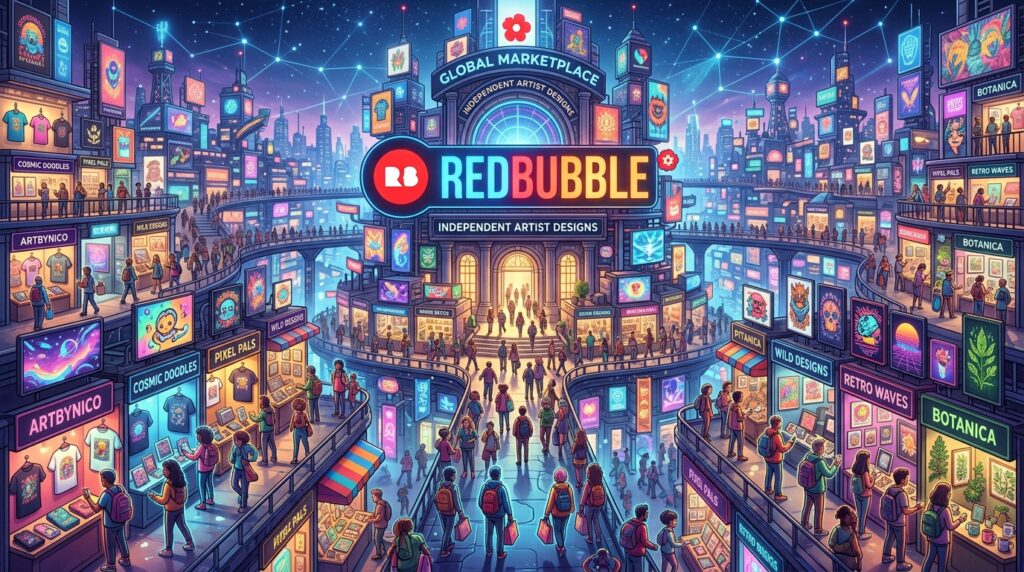
Redbubble is fundamentally different from the first two. It is a Marketplace, not a fulfillment tool. You don’t need to build a website or do your own marketing; Redbubble already has millions of monthly shoppers.
- The “Upload and Forget” Model: You simply upload your art, choose which of the 70+ products it looks best on, and let Redbubble handle the rest. They provide the traffic, the customer service, and the shipping.
- Built-in SEO: In 2026, Redbubble’s internal search algorithm is highly sophisticated. If you tag your work correctly (e.g., “Vintage 90s Vaporwave Synth Cat”), your design will appear in front of buyers who are specifically looking for that aesthetic.
- Artist Tiers & Commissions: While Redbubble takes a larger “cut” than Printify, it is the only platform that is truly passive. You set your “Artist Margin” (usually 20%), and every sale results in a direct deposit to your PayPal without you lifting a finger.
- Fan Art Program: Redbubble has official partnerships with major brands (Netflix, Rick & Morty, etc.). In 2026, this is the only legal way for “fan artists” to sell merch based on their favorite shows without getting a copyright strike.
4. Gelato: The Global Sustainability Leader
Gelato has become the go-to for 2026’s “Eco-Conscious” creator. Their mission is to “Produce Locally, Ship Globally,” which drastically reduces the carbon footprint of every order.
- Production in 34 Countries: Gelato has a massive network of local printers. If a customer in France orders your poster, it is printed in France. This reduces shipping times to as little as 48 hours and eliminates expensive international customs fees.
- Wall Art Specialist: While they do apparel, Gelato is the undisputed leader in High-End Wall Art and Photo Books. Their paper quality and framing options are the highest in the free POD category.
- Mobile-First Design: The Gelato app in 2026 is a powerhouse, allowing you to manage your entire international business from your phone—including real-time tracking of every shipment globally.
- Sustainability Labeling: Gelato allows you to display “Eco-Friendly” badges on your products, a feature that 82% of 2026 consumers say influences their purchasing decisions.
5. Zazzle: The King of Customization
Zazzle is the best choice for products that require Customer Input. If you want to sell a “Custom Name” bridesmaid robe or a “Personalized Graduation” invitation, Zazzle’s tech is unmatched.
- The “Template” Engine: Zazzle allows you to create “Templates” where the customer can type in their own text or upload their own photo directly onto your design.
- Huge Product Breadth: Beyond shirts, Zazzle offers unique items like custom playing cards, wrapping paper, and luxury stationery that other POD sites ignore.
- Zazzle LIVE: A 2026 feature that allows you to provide “live design assistance” to customers for a higher royalty fee, turning your shop into a personalized service.
- High Trust Factor: Zazzle is a legacy brand with massive organic traffic, making it a “safe” place for buyers to spend their money on expensive, personalized gifts.
Comparison: Which POD Platform Should You Choose?
| Platform | Best For | Business Model | Top Feature |
| Printify | High Profits | Fulfillment Network | 1,000+ Products |
| Printful | Branding | In-house Printing | Premium Labels & Embroidery |
| Redbubble | Passive Income | Marketplace | Built-in Traffic |
| Gelato | Global Shipping | Localized Production | 34-Country Local Printing |
| Zazzle | Customization | Marketplace | User-Editable Templates |
The 2026 POD Success Blueprint: 3 Steps to Profit
Simply uploading a design isn’t enough in 2026. To actually make sales, you must follow the “Three-P System”:
- Placement (SEO): Whether on Etsy or Redbubble, your “Tags” are your lifeblood. Use tools like EverBee or eRank to find “Low Competition, High Volume” keywords. Instead of “Funny Shirt,” try “Retro Sarcastic Nurse Hoodie.”
- Presentation (Mockups): In 2026, standard flat mockups don’t sell. Use AI tools like Mockey or Placeit to create “Lifestyle Mockups”—showing your product being worn by a person in a realistic setting (e.g., a coffee shop or a mountain trail).
- Promotion (Short-Form Video): You don’t need an ad budget. Use TikTok and Instagram Reels to show the “Process” of your design or the “Reaction” to a sample. In 2026, Social Commerce accounts for 40% of all POD sales.
Final Thoughts
Print-on-Demand in 2026 is the ultimate “low-risk, high-reward” venture. Whether you choose the massive scale of Printify, the premium touch of Printful, or the passive ease of Redbubble, the only real barrier to success is starting.
The tools are free. The fulfillment is automated. The market is global. Your only job is to create something that people want to own.