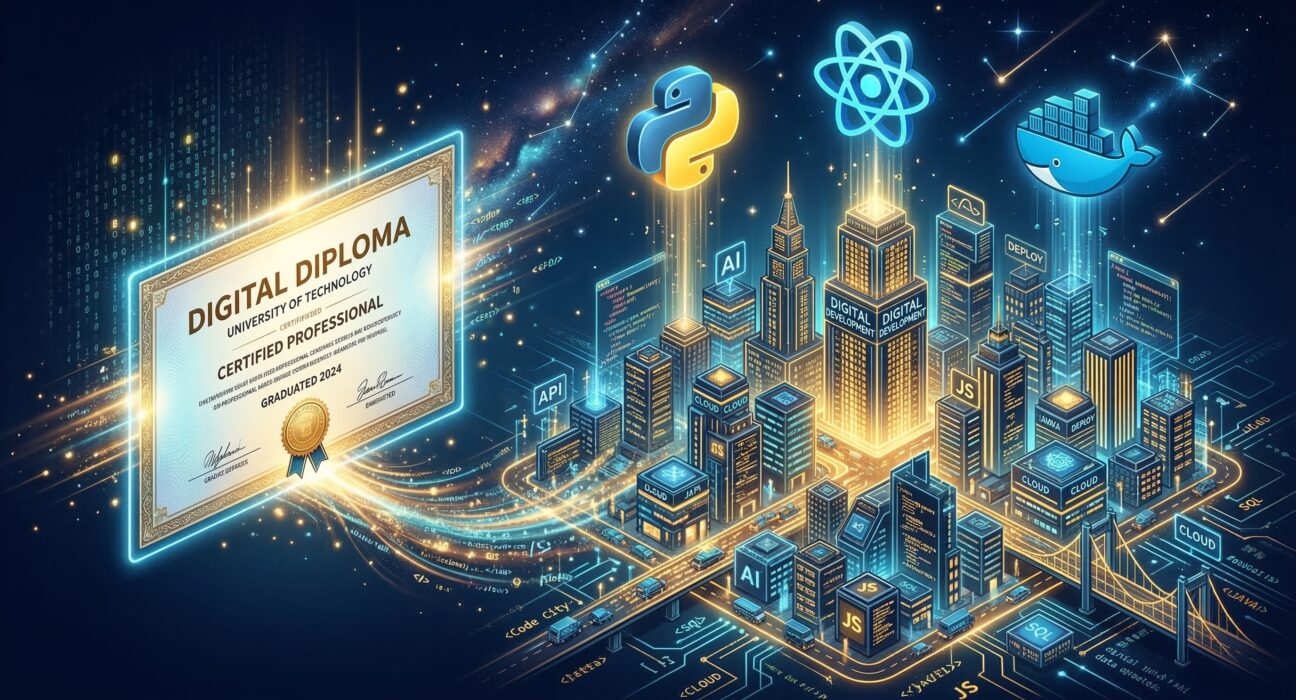
In 2026, the traditional four-year computer science degree has faced its “Galileo moment.” While prestigious universities still hold weight, the Proof of Skill has surpassed the Proof of Attendance. We have entered the era of the “Self-Taught Architect,” where individuals use open-source curricula to build systems that rival those designed by Silicon Valley veterans.
The “Golden Rule” of 2026 programming education is Modernity and Tooling. Learning syntax is trivial; learning how to navigate a terminal, manage a CI/CD pipeline, and collaborate via Git is where the real value lies. The platforms that dominate 2026 are those that treat you like a professional from day one.
The most effective way to master engineering in 2026 is to embrace “Friction-Based Learning.” If it’s easy, you aren’t learning. The courses listed below are famously difficult—and that is exactly why they are the most valuable.

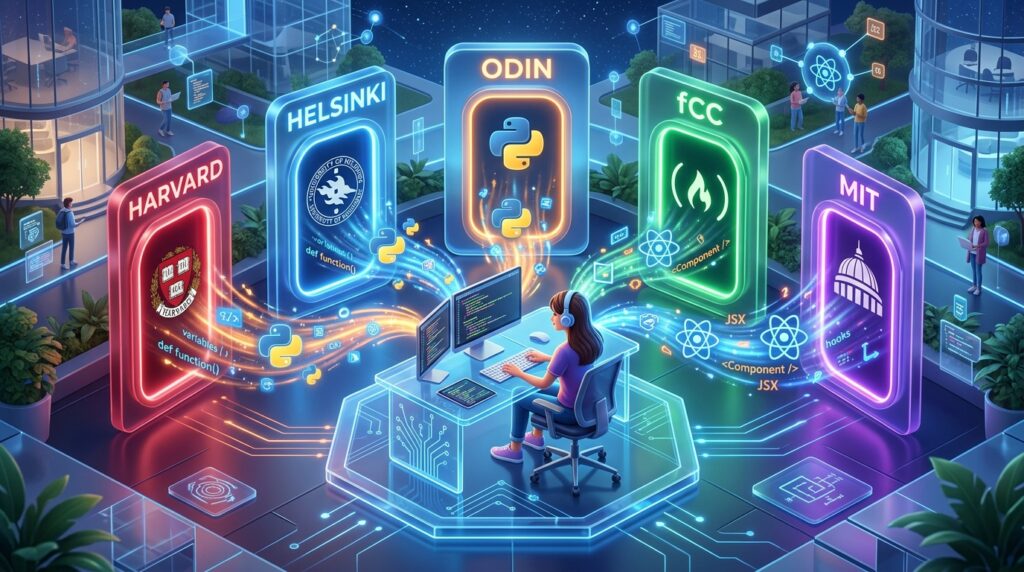
1. Harvard CS50: The Intellectual Foundation
CS50 (Introduction to Computer Science) is more than a course; it is a global phenomenon. In 2026, it remains the gold standard for anyone who wants to understand the soul of computing rather than just “how to make a website.”
- The 2026 AI Evolution: Under the leadership of David J. Malan, the 2026 version of CS50 has integrated a specialized “Artificial Intelligence for Everyone” module. It doesn’t just teach you to use AI; it teaches you how LLMs (Large Language Models) work at the data structure level, ensuring you are the master of the tool, not its servant.
- Low-Level Mastery (C to Python): You start in C—a language that forces you to manage memory manually. This is the “trial by fire” that separates real engineers from hobbyists. By the time you reach Python and SQL in the second half of the course, you understand why the code works, not just that it works.
- The “CS50 Duck” AI Tutor: In 2026, every student has access to an AI rubber duck tutor that doesn’t give answers but provides Socratic hints, mimicking a one-on-one session with a Harvard TA.
- The Final Project Fair: Your final project is your calling card. In 2026, the CS50 project gallery is actively scouted by recruiters looking for “Foundational Thinkers.”
A common mistake to avoid is skipping the “C” portion of the course because it’s hard. In 2026, understanding memory management and pointers is what will make you irreplaceable in a world of high-level AI abstractions.
2. The Odin Project: The “Real-World” Simulation
If CS50 is the “University,” The Odin Project (TOP) is the “Apprenticeship.” It is arguably the most rigorous free resource for becoming a Full-Stack JavaScript or Ruby on Rails Developer in 2026.
- Local Environment Setup: TOP refuses to use a browser-based code editor. From Lesson 1, you are forced to install Linux (or WSL2), configure VS Code, and master the Terminal. This “Initial Friction” ensures that when you land your first job, you already know how to use a professional developer’s workstation.
- Curated Intelligence: TOP doesn’t just write its own content; it scours the internet for the best articles, documentation, and videos on a specific topic. This teaches you the most important skill in 2026: The ability to read documentation and find answers independently.
- The “Battleship” Milestone: Their projects are legendary for their difficulty. Building a Battleship game using Test-Driven Development (TDD) in JavaScript is the moment most students “become” developers.
- Open Source Contribution: By the end of the course, you are encouraged to contribute back to the TOP codebase on GitHub, giving you your first “Green Squares” on a major production repository.
3. Full Stack Open (University of Helsinki): The “Modernity” King
While other courses might teach “legacy” tech, Full Stack Open from the University of Helsinki is the course for those who want to be on the Bleeding Edge.
- TypeScript-First Philosophy: In 2026, JavaScript is rarely used in large-scale production without types. Full Stack Open has moved to a TypeScript-mandatory curriculum, ensuring you are prepared for the strict standards of modern enterprise codebases.
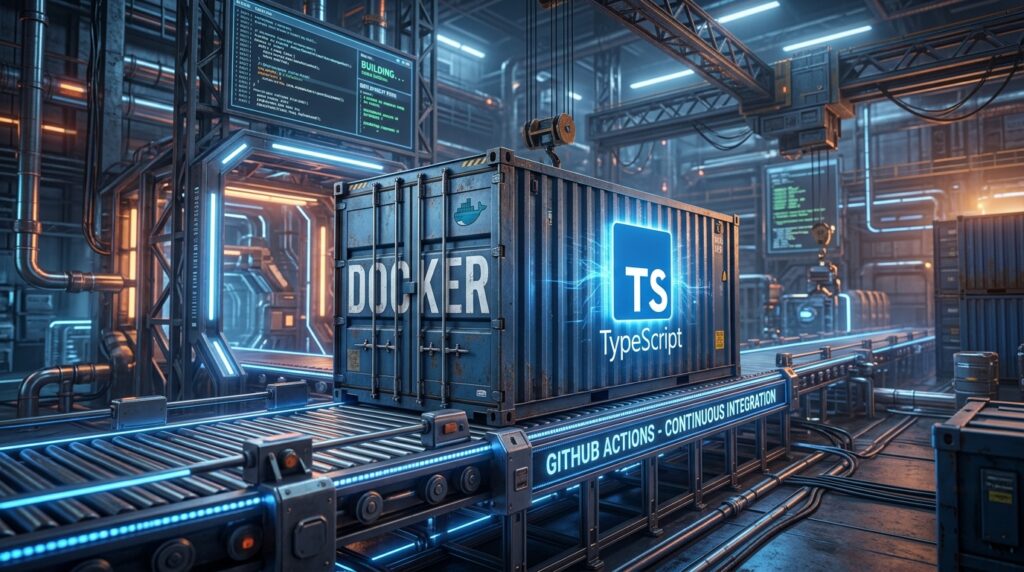
- The Full “DevOps” Cycle: This course doesn’t stop at the UI. You learn Docker, CI/CD with GitHub Actions, and React Query for state management. This is the only free course that truly bridges the gap between “coding” and “shipping software.”
- Industry-Standard Testing: You learn the “Testing Pyramid”—unit tests with Vitest, integration tests, and end-to-end testing with Playwright. In 2026, a developer who can’t write tests is a liability; this course makes you an asset.
- University Credits for Free: If you are in the EU, you can actually earn ECTS credits. For the rest of the world, the certificate is highly respected because of its affiliation with one of Europe’s top research universities.
4. freeCodeCamp: The “No-Barrier” Path
freeCodeCamp (fCC) is the world’s largest non-profit coding community. In 2026, it serves as the ultimate “Entry Point” for career changers who need a clear, linear path with zero setup.
- Project-Based Certifications: Each of their 12 certifications (Responsive Web Design, JS Algorithms, Machine Learning with Python, etc.) requires you to build 5 full-scale projects.
- The 2026 “Scientific Computing” Expansion: fCC has heavily invested in its Data Science and AI tracks. You can now earn certifications in Data Analysis with Pandas and Machine Learning with TensorFlow, all through an interactive, browser-based environment.
- The “Job-Ready” Interview Prep: Their 2026 Interview Prep section contains over 1,000 hours of coding challenges, ranging from “Easy” to “Google-Interview-Hard,” ensuring you can pass the technical screen after you finish the learning.
- Global Alumni Network: With over 40,000 alumni at companies like Google and IBM, the fCC “brand” is recognized by automated resume scanners (ATS) worldwide.
5. MIT OpenCourseWare (6.0001 & 6.0002): The Academic Elite
For those who want the MIT Experience without the $60,000 price tag, MIT OCW provides the full lecture sets, assignments, and exams from their “Introduction to Computer Science and Programming in Python.”
- Computational Thinking: MIT doesn’t just teach Python; it teaches you how to use computation to solve complex math and science problems. This is the best course for those interested in Data Science, Finance, or Engineering.
- Advanced Algorithms (6.006): Once you finish the intro, MIT OCW offers the world-renowned “Introduction to Algorithms” course. In 2026, being an “Algorithm Specialist” is the fastest way to a high-seniority salary.
- Peer-Reviewed Quality: Every assignment has “Instructor Solutions,” allowing you to compare your code to how an MIT professor would have written it. This “Gap Analysis” is the fastest way to improve your code quality.
- Lifetime Access: There is no “Enrollment Period.” You can download the entire course—videos, PDFs, and code—and study it in the middle of the woods if you want.
Comparison: Which 2026 Course Matches Your Persona?
| Course | Best For | Focus | 2026 “X-Factor” |
| Harvard CS50 | Absolute Beginners | Fundamentals / AI | The “CS50 Duck” AI Tutor. |
| The Odin Project | Web Developers | Local Dev / Mastery | Battleship Project with TDD. |
| Full Stack Open | Mid-Level / Pros | Modern Stacks / DevOps | Mandatory TypeScript & CI/CD. |
| freeCodeCamp | Career Changers | Breadth / Projects | Machine Learning with Python. |
| MIT OCW | Math & Science Nerds | Theory / Algorithms | MIT-Grade Algorithm Challenges. |
The 2026 “Developer Roadmap”: How to Stack These Courses
To reach a senior-level salary ($150k+) in 2026, do not just pick one. Stack them:
- Month 1-3 (The Foundation): Complete CS50x. Get your “Generalist” brain working.
- Month 4-8 (The Specialization): Move to The Odin Project. Build your local portfolio. This is your “Proof of Work.”
- Month 9-12 (The Professionalization): Finish with Full Stack Open. Learn how to containerize your apps and write TypeScript.
- Ongoing (The Grind): Use freeCodeCamp’s Interview Prep for 30 minutes every morning to stay sharp for technical screenings.
Final Thoughts
Programming in 2026 is the ultimate “Superpower.” You are no longer just a “coder”; you are a Solution Architect. By using these five free courses, you aren’t just saving money—you are gaining access to the exact same knowledge that built the modern world.
The gatekeepers are gone. The lectures are public. Your future is a repo away.