
For over a decade, the question wasn’t if you should use jQuery, but how quickly you could get it into your project. However, as we navigate through 2026, the web development landscape has shifted dramatically. With the recent release of jQuery 4.0 and the massive advancements in native browser APIs, the choice between “Vanilla” JavaScript and libraries is no longer about capability—it’s about strategy.
The most effective way to decide your stack is to evaluate your project’s lifecycle. While Vanilla JS offers unmatched performance, jQuery still powers over 75% of the web. This step-by-step guide to choosing your JS path will break down the performance, syntax, and real-world utility of both options in the current year.
1. Performance: The Lightweight King
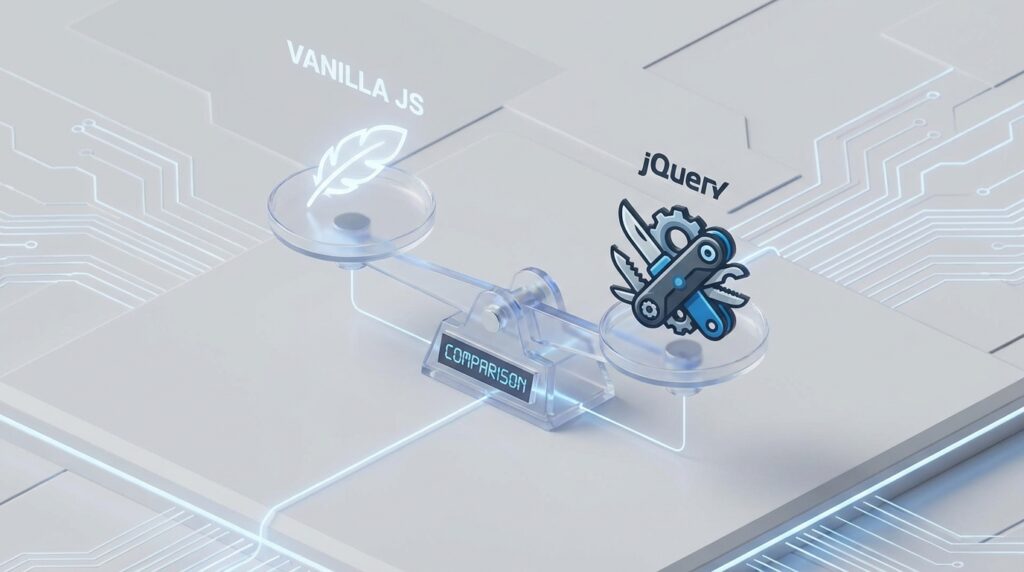
In 2026, page speed is a non-negotiable ranking factor for Google. Based on industry research, Vanilla JS is roughly 2x to 5x faster than jQuery because it interacts directly with the DOM without an abstraction layer.
- Zero Overhead: Vanilla JS requires no external library download (saving ~90KB).
- Direct Execution: Browsers execute native commands like
document.querySelectorinstantly, whereas jQuery must first “translate” its code into native JS.
2. The jQuery 4.0 Renaissance
Wait, isn’t jQuery dead? Far from it. In early 2026, the jQuery team released version 4.0, which officially dropped support for legacy browsers like IE10. This modernized the library, making it:
- Security Focused: Improved compatibility with strict Content Security Policies (CSP).
- Slimmer: By removing deprecated code, it’s more efficient for those who prefer its “Chaining” syntax ($H_3$ example:
$(el).addClass().show().css()).
3. Syntax Comparison: Then vs. Now
A common mistake to avoid is assuming Vanilla JS is still “verbose” or difficult. Look at how modern ES6+ has closed the gap:
| Task | jQuery Syntax | Modern Vanilla JS (2026) |
| Select Element | $('.btn') | document.querySelector('.btn') |
| Ajax / API | $.get(url, data) | fetch(url).then(res => res.json()) |
| Add Class | $(el).addClass('active') | el.classList.add('active') |
4. When to Choose jQuery in 2026
Despite the speed of Vanilla JS, jQuery is still the best choice for:
- WordPress Development: Since the WordPress core and thousands of plugins rely on it, using it prevents “double-loading” multiple libraries.
- Rapid Prototyping: If you need a functional MVP in hours, jQuery’s massive plugin ecosystem (sliders, modals, date-pickers) is unbeatable.
5. When to Choose Vanilla JS
You should stick to Vanilla JS for:
- Performance-Critical Apps: If you are building a tool where every millisecond counts.
- Chrome Extensions: To keep your extension bundle small and pass the strict Manifest V3 security audits.
Final Thoughts
In 2026, the “vs” in Vanilla JS vs. jQuery is less about a fight and more about a fit. For high-performance, modern web apps, Vanilla JS is the clear winner. However, for maintaining the millions of existing WordPress sites or building fast-turnaround business tools, jQuery 4.0 remains a reliable, mature ally.
Leave feedback about this